
Why negotiation matters before business cooperation begins — especially when responsibilities, timelines, payments, and expectations need to be clearly understood.
Before any business cooperation begins, negotiation plays an important role.
It is not only about price. It is not only about changing terms. It is not about conflict or pressure.
Negotiation is a structured business step that helps both sides understand what they are agreeing to before work starts.
In business, especially in cross-border cooperation, clear terms matter. Different parties may have different expectations about payment, responsibilities, timelines, documents, communication, and results. If these expectations are not discussed early, confusion can happen later.
A good negotiation helps prevent that.
It allows both sides to clarify the value of the service, the scope of work, the limits of responsibility, and the structure of cooperation.
This is why negotiation before cooperation is not a delay. It is part of building a stronger business relationship.
Negotiation Helps Both Sides Understand the Value of the Service
One of the most important reasons to negotiate before cooperation begins is to clarify value.
In many service-based businesses, the price does not only represent one simple action. It may include communication, coordination, administrative preparation, follow-up, document review, partner communication, time, knowledge, and responsibility.
Without proper explanation, a client or partner may only see the final result. They may not see the work behind the process.
Negotiation allows the service provider to explain what is included and why the service has a certain value. It also gives the client or partner an opportunity to ask questions and understand what they are paying for.
This creates a better foundation because the cooperation begins with understanding, not assumptions.
When the value is clear, the conversation becomes more focused and businesslike. Both sides can make decisions based on scope, responsibility, and expectations — not only on price.
Clear Terms Prevent Misunderstandings Later
Many business problems do not begin because people have bad intentions.
They often begin because the terms were not clear enough from the start.
One party may think the service includes one thing, while the other party understands something different. One side may expect immediate results, while the other side knows that the process depends on documents, third parties, authorities, employers, or external timelines.
This is why clear terms are important before cooperation begins.
A clear agreement should answer basic questions such as:
What service is being provided?
When does the work officially start?
What documents or information are required?
What is included in the service?
What is not included?
When should payment be made?
What happens if there are delays?
Who is responsible for which part of the process?
When these points are discussed early, both sides have a better understanding of the cooperation.
Clear terms do not remove every possible challenge, but they reduce confusion and help both parties manage expectations in a more organized and reliable way.
Payment Structure Should Be Discussed Before Work Starts
Payment terms are one of the most important parts of any business cooperation.
They should not be treated as a small detail.
In service-based work, the payment structure helps protect the process. It confirms the client’s or partner’s commitment and allows the service provider to begin work on a clear basis.
Depending on the type of service, payment may be structured as an upfront payment, a staged payment, a payment before document submission, or a payment after certain agreed-upon steps.
What matters most is that both sides understand the payment structure before the cooperation begins.
For example, if a process requires coordination, administrative preparation, communication with partners, or document-related support, the service provider may need partial payment before starting work. This is not only about money. It is also about managing time, workload, and commitment.
Clear payment terms help avoid situations where work begins, but payment expectations are unclear.
A structured payment arrangement protects both parties by linking the work process to agreed-upon business terms.
Scope of Service Must Be Defined Early
Another important part of negotiation is defining the scope of service.
The scope explains what the service provider will do and what the client or partner should not expect unless separately agreed.
This is especially important in consulting, coordination, administrative support, and cross-border cooperation because many processes involve different parties.
For example, a service provider may coordinate communication, assist with document collection, support administrative steps, or help clarify requirements. However, this does not always mean the provider controls the decisions of employers, authorities, embassies, government offices, or other third parties.
If the scope is not clear, one side may expect guarantees that the service provider cannot legally or practically give.
This is why the scope should be discussed before work begins.
A clear scope protects the client because they understand what support they will receive.
It also protects the service provider because responsibilities are defined and realistic.
Good cooperation begins when both sides know exactly what is included.
Timelines Should Be Realistic, Not Assumed
Timelines are another common source of misunderstanding in business cooperation.
A client may expect a fast result. A partner may expect documents within a certain period. A service provider may know that the process depends on external factors.
If timelines are not discussed clearly, one side may feel disappointed even when the delay is outside the service provider’s control.
This is very common in cross-border processes, recruitment coordination, administrative support, and documentation-related services.
Some timelines may depend on document completeness, client response time, employer availability, partner processing time, government or authority decisions, appointment availability, changes in procedure, or external delays.
Because of this, timelines should be explained as realistic working estimates, not guarantees, unless a guarantee is truly possible.
Clear timeline discussions help both sides understand what can be controlled and what cannot.
This makes the cooperation more transparent, organized, and reliable.
Written Agreements Protect Both Parties
Verbal discussions can be useful, but they are not enough for serious business cooperation.
A written agreement gives structure to what both sides discussed. It helps prevent confusion and provides a clear reference if questions arise later.
Written agreements may include contracts, annexes, invoices, written orders, email confirmations, or service descriptions.
The purpose is not to make the process complicated.
The purpose is to make the cooperation clear.
A well-written agreement should reflect the actual understanding between the parties. It should include the scope of service, payment terms, responsibilities, limitations, timelines, and any special conditions.
This is especially important when cooperation involves international partners, documentation, recruitment coordination, or administrative processes.
When terms are written clearly, both sides can return to the agreement instead of relying only on memory or assumptions.
A written agreement is not a sign of distrust.
It is a sign of serious and well-structured cooperation.
Not Every Cooperation Is the Right Fit
Negotiation also helps both sides understand whether the cooperation is the right fit.
Sometimes, after discussing the terms, both parties realize they are aligned.
Sometimes, they need to adjust certain points.
Sometimes, they realize that their expectations are too different.
This is not necessarily a failure.
It is better to discover misalignment before work begins than after time, money, and resources have already been invested.
A good business relationship should be based on clear expectations, realistic terms, and mutual understanding.
If one side expects guarantees that cannot be given, or wants responsibilities that the other side cannot accept, negotiation helps reveal that early.
In this way, negotiation protects both parties from entering into cooperation that may later become difficult or unclear.
The right cooperation is not only about opportunity.
It is also about alignment.
Clear Negotiation Builds Better Business Relationships
When negotiation is handled with clarity and structure, it can strengthen the relationship between both sides.
It allows each party to ask questions, explain concerns, clarify responsibilities, and understand the value of the cooperation.
This creates trust.
Trust does not come only from friendly communication. It also comes from clear terms, realistic expectations, and a well-organized structure.
When both sides know what they are agreeing to, cooperation becomes smoother.
There is less confusion.
There are fewer assumptions.
There is better communication.
There is a stronger foundation for future work.
This is why negotiation should not be avoided.
It should be treated as part of responsible business practice.
Conclusion: Clear Terms Create Stronger Cooperation
Negotiation before cooperation is not about conflict.
It is about clarity.
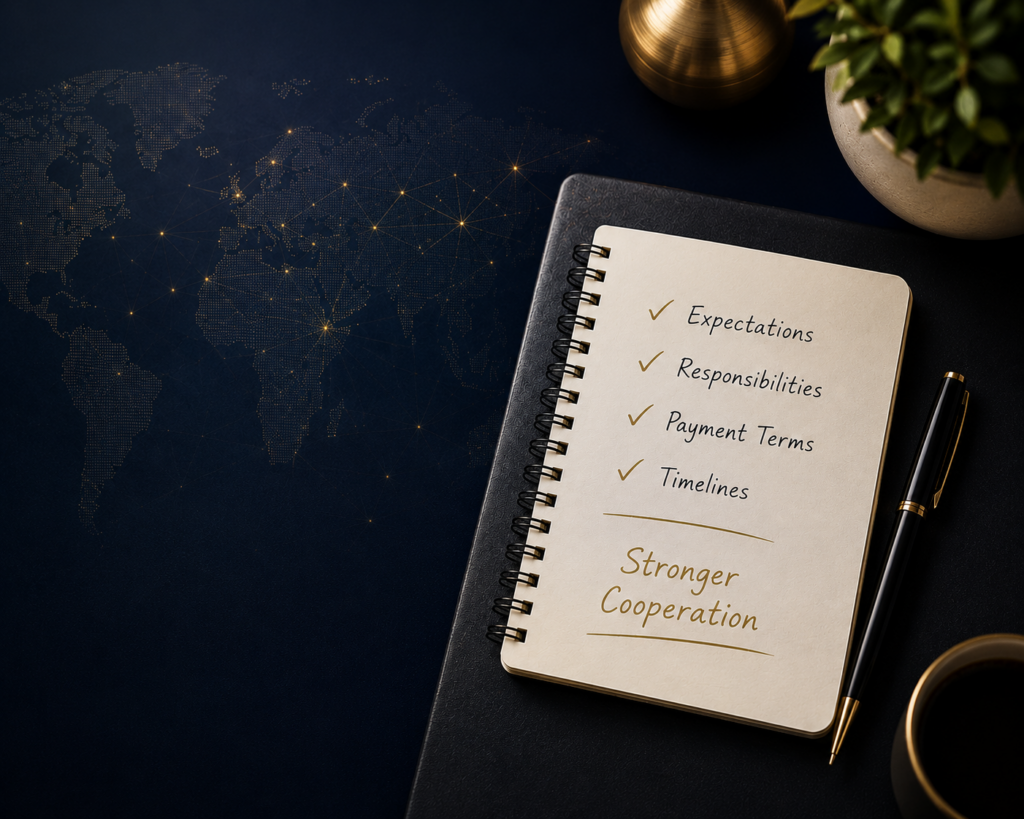
It helps businesses understand the value of the service, define responsibilities, agree on payment structure, discuss realistic timelines, and protect both parties through written terms.
In business cooperation, especially across borders, assumptions can create problems. Clear terms help prevent those problems before they begin.
A strong business relationship does not start only when work begins.
It starts when both sides understand what they are agreeing to.
At Astoria International Consulting, we believe that business cooperation should be built on clarity, structure, and realistic communication. Through coordination, administrative support, and cross-border business assistance, we help businesses approach cooperation with better organization and clearer expectations.
Need structured support for your international hiring or business coordination process?